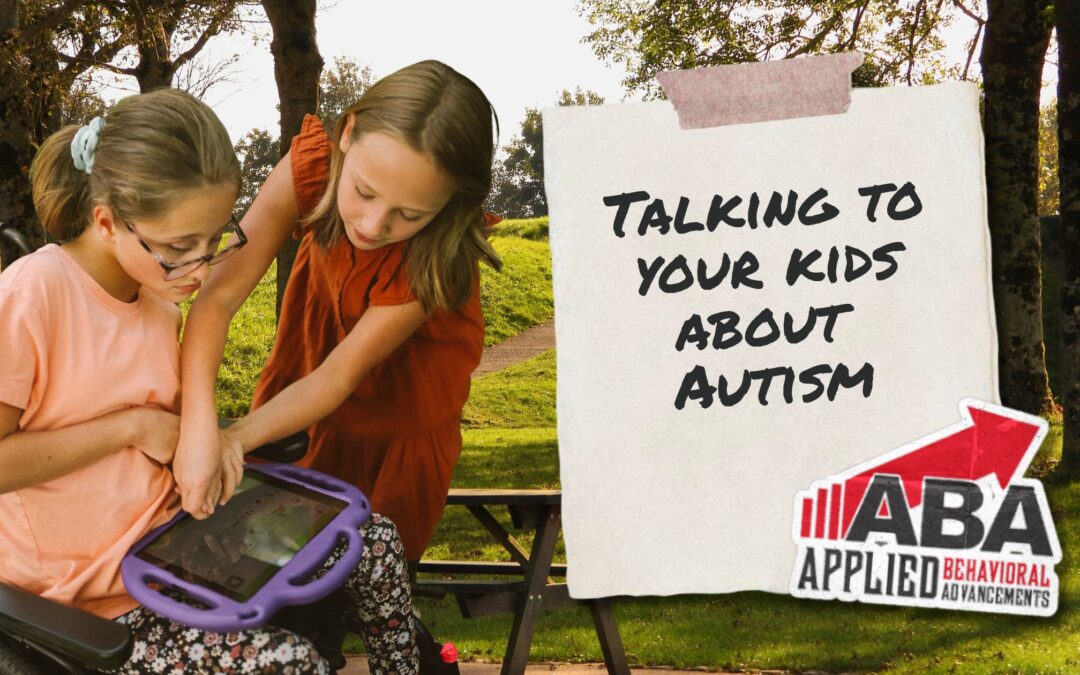
Nervous about talking to kids about autism?
Autism is a part of everyday life. Like anything else in life, it is natural for kids to have questions about what an Autism diagnosis is and what it means. According to the CDC in 2025, 1 in 31 children in the US have an autism diagnosis. Regardless of if a child has an autism diagnosis themselves, its likely they know a friend of family member who does. As parents and teachers, we can help guide our children’s understanding of Autism and guide them to a compassionate, neurodiversity affirming perspective.
This blog will help walk parents through talking to your kids about autism with respect and empathy. We will draw on advice from the experts about how you can embrace Autism at every stage of your child’s development, from elementary school aged kids to teenagers and beyond.
The earlier you start talking to your kids about autism – the better. Unfortunately, we live in a society that is a biased towards neurotypical individuals. You can make a positive impact on the world by raising compassionate children who challenge the status quo with empathy. For kids on the Spectrum, a positive perspective is more than essential. Doctors report that kids who grew up in households where autism was discussed reported a more positive association with their identity.
What is autism?
Autism Spectrum Disorder (ASD) is a developmental disability that affects how a person communicates, learns, and engages with the world. It is a lifelong condition that cannot be grown out of or “cured.” The spectrum of Autism contains a multitude of individuals, all with their own unique experiences. Some people with autism live independent lives within their communities, while others may require lifelong care and assistance.
The most important thing to remember is: because autism is a spectrum, there is no singular way it manifests. If you’ve met one autistic person, well, then you’ve met one autistic person. It does not mean you can blanket apply their experiences to every other autistic person you meet. Remember when talking to kids about autism to emphasize the importance of respecting each person’s individual experience.
Talking to kids about autism – Young Kids
How do you explain autism to young kids, around ages 4 and up?
Young kids think in concrete, observable terms. You should avoid being overly clinical, or trying to explain “why” someone is autistic. Just frame it as one of the many natural differences between people. Remind them that everyone is unique, but everyone is natural. A person who has unique physical characteristics or engages in non-neurotypical behavior is different, and that’s okay! We are all different in our own way. Different is something to be curious about.
The simplest definition of autism you can use for a child is “someone whose brain works in a unique way that might affect the way they play and make friends.” If they have specific questions about something an autistic person is doing, remind them that everyone is different and they can be kind and patient.
There are many age-appropriate books and tv-shows that represent autistic characters.
Talking to kids about autism – Tweens
Older kids ages 8 and up can handle more information.
You can give more examples of how brains are wired differently and encourage them to act inclusively. You can even begin to teach kids about neurodiversity – the idea that differences in the way a person’s brain works is no different than how kids are different heights or have different hair colors.
Remember to point out the strengths that people with autism might have. Everyone has special gifts to offer, teach your kids to recognize them even when they’re outside of what society values.
Talking to kids about autism – teens
Teens and older pre-teens value honest conversations where adults take them seriously. For this age group, do your best to answer their questions openly.
By the time kids are teens, they’ve probably been exposed to harmful ideas about autistic people. It’s important to impress upon them that all people are valuable. Talk to your teens about autistic people they know and how they are treated by society. What does being a good friend to an austic person look like? How can be advocates for inclusion?
Don’t be afraid to talk to your teens about the challenges faced by autistic people. Teens can handle complex ideas – like how some conditions having common challenges does not mean that the condition is something to be ashamed of.
One great way you can encourage teenagers to learn more about autism is by encouraging them to seek out books, podcasts, and social media content created by autistic self-advocates.
A Positive Perspective
Autistic kids deserve your unconditional love and support. The truth is, though we learn more about autism every year, some people hold on to outdated or harmful ideas. Others are more concerned with judging people that are different than they are acceptance. So in a world inundated with negativity, offer your kids a positive and neurodiversity affirming perspective. Every person is born perfect, it’s the world that doesn’t always know how to accommodate them. Each of us has a role to play in creating a better, more inclusive world.
Start with yourself
Remember to start with your own perspective of autism. What societal messages have you internalized? What have you learned from doctors, therapists, friends? What have you observed in your own life? It’s likely that what you’re holding several perspectives about autism already – hopefully, including unconditional love and support for your children. This is the perspective to lead from whenever possible.
The best way to expand and challenge your perspective on autism is to learn from autistic individuals. We strongly encourage you to seek out resources from Autistic Self Advocates. Find influencers who talk about their life living with autism, or famous figures who are themselves autistic. Many of these individuals could serve as great role models for your autistic child, but they will also serve as a reminder that autism looks a little different on everybody. Autistic people are capable of incredible things!
Neurodiversity
The term Neurodiversity, coined by Judy Singer in the 1990s, has gained significant popularity in the last few years. It encourages people to adopt the perspective that everyone’s brain working uniquely is a natural aspect of human biodiversity. So instead of seeing autism, ADHD, ADD, or Dyspraxia as deficits, we see them as natural. This is a powerful shift that reminds us there is no one right way of thinking or experiencing the world.
When somebody or something embraces the neurodiversity mindset, we might say its “neuro-affirming.”
Strengths and Challenges
Just because autism itself is not a deficit, does not mean that some autism diagnoses don’t come with significant challenges. People with autism, like anybody else, deal with both strengths and challenges. So when we talk about autism, it’s important to speak about both.
Remember – if someone you love with autism is facing significant challenges, treatment offers hope for both individuals and families. Applied Behavior Analysis (ABA) is a science-backed approach to teaching individuals new skills and reducing challenging behavior. Learn more about ABA services offered through ABA-LLC.
About ABA-LLC
ABA-LLC is one of the largest suppliers of Behavior Support in the state of Kentucky. Since 2007, the agency has created innovative strategies to improve the lives of unique individuals. ABA-LLC works with around 190 contractors, each dedicated to building an inclusive culture that celebrates individuals of all abilities. No matter who you are, you can reach your goals at ABA-LLC.
ABA-LLC is set apart from its competitors by its uniquely person-centered approach. The agency strives to provide services from a place of deep love for the population it serves. Their work exemplifies the belief that every individual has a right to live a fulfilling and independent life integrated within their communities. There is no objective to change a person, but rather to give them the tools they need to succeed. B.F. Skinner summarizes this vision in his quote: “I’m not trying to change people. All I want is to change the world in which they live.” Learn more about us at https://aba-llc.com/