“You need to calm down!”
When has hearing those words ever made anybody calmer?
Luckily, there’s ABA Calming Strategies.
Learning how to cool off when tensions run high is an essential skill for fulfilling, independent living. But most people are not born knowing how to calm down. Using the data-verified science of Applied Behavior Analysis, we can effectively teach learners of all ages to learn new calming strategies and integrate them into daily life. Using calming strategies improves mental and physical health, promotes independence, and can be an effective tool for reducing challenging behaviors.
In this blog post, we will teach you what Calming Strategies are, their benefits, and how to teach them effectively using ABA. Then, we will go over a few proven strategies that you can try to use for yourself or others. Remember, what works for one person will not work for everyone. When it comes to ABA Calming Strategies, it’s important to offer a variety of strategies.
The information in this blog post is based on a presentation by Amber Durr, MA, BCBA, LBA, in collaboration with our educational program CoachABA.
About Amber
Amber began working for ABA in 2007 as a Behavior Specialist and obtained her Board Certification in 2010. The timing of everything worked out just right, as she met Chris when he was building ABA from the ground up. It was easy for her to shift from her full time job at a Psychiatric Hospital seamlessly into a contractor role with ABA. In 2024, she obtained her certification as a Zumba instructor. Amber is passionate about leading Zumba classes for ADTs in Louisville as well as to her clients, staff, therapists, etc. Amber describes it as a dream come true to be able to combine her passion for her clients with her love of Salsa dancing!
Outside of work, she enjoys practicing yoga and meditation, creating art, cooking, working in the yard, hiking, traveling, and spending time with her husband Jamie and her two dogs Reggie and Elsa Jean. In all parts of life, Amber loves to learn and have fun.

What are Calming Strategies?
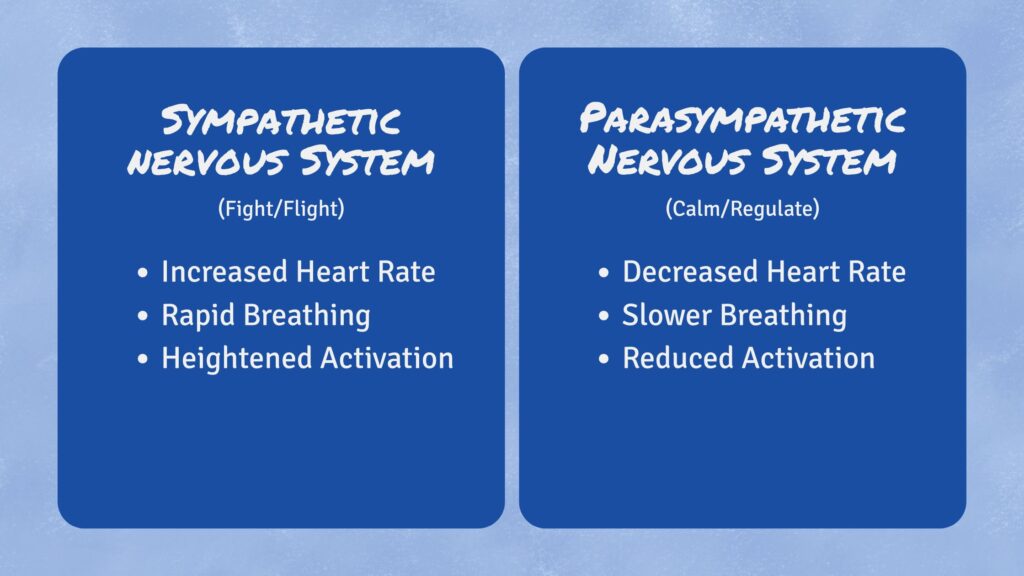
ABA Calming Strategies are techniques designed to help a person regulate their emotions. When we experience distress, anxiety, fear, or anger – our nervous system might shift activate into Sympathetic mode. Commonly, you might hear this referred to as Fight/Flight mode. Calming strategies can help us shift into Parasympathetic mode, where we feel Calm/Relaxed.
Calming strategies look a little bit different for everyone. Commonly, we hear about things like deep breathing, journaling, listening to music, or taking a walk outside. These are all wonderful strategies for lots of people! However, some of our clients at ABA-LLC have seen success using truly unique strategies. For example, one of our clients enjoys listening to firetruck noises to help regulate themselves, and another likes to count how many individuals they see wearing buns. What a person does doesn’t matter as much as the effect it has on the individual.
Benefits of ABA Calming Strategies
Calming Strategies have immense benefits. First and foremost, they can help turn moments of crisis into moments of zen. But as an individual learns to practice calming strategies regularly, they will discover that Calming Strategies can help:
- Regulate Emotions
- Reduce Physiological Activations
- Maintaining Behavioral Control
- Reduce challenging behaviors over time
- Promote independent self-regulation
- Support the utilization of functionally equivalent behaviors.
How to Teach ABA Calming Strategies Effectively
ABA Calming Strategies are most effective when they are…
- Taught Proactively
- Used Consistently
- Reinforced Immediately
As we hinted at the beginning of this blog post, the ideal time to teach someone a new calming strategy is not when they begin to panic. Ideally, calming strategies should be taught in the natural setting in the absence of challenging behaviors. For our purposes, ABA Calming Strategies taught to others should be introduced and implemented under the guidance of a Behavior Analyst.
When deciding what calming strategies to teach the participant, have an open conversation with them about their feelings. What things upset them? What things already make them feel calm?
Once the ABA calming strategies have been taught by a Behavior Analyst, the individual should be reminded to use these calming strategies whenever is appropriate. Like any other skill, building personal calming strategies takes practice and repetition. Practicing calming strategies when we don’t need them strengthens the muscle for when we do.
When the individual participates in a calming strategy, any caretakers should verbally praise the participant. Positive reinforcement is the cornerstone of Applied Behavior Analysis. Reinforcement encourages the participant to repeat the good behavior in the future.
Over time, both reinforcement and prompting will gradually be faded under the guidance of the Behavior Analyst.
ABA Calming Strategies
For ease of reading, we have broken the strategies down into four categories. As you read, you may notice that there is overlap between some of the categories. Each individual is experiment to find which strategies work best for them.
Deep Breathing
Deep breathing is an easy, natural way to calm your nervous system. These strategies are wonderfully flexible, as they can be performed almost anywhere for any duration of time. In addition to naturally calming the nervous system, focusing on the breath grounds us in the present moment. There are a number of different deep breathing techniques that include:
- Box Breathing
- Lion’s Breath
- 5-7-8 Breathing
- Belly Breathing
- Balloon Breathing
- Triangle Breathing
- Bee Breathing
- Bear Breathing
- Flower Breathing
- Candle Breathing
Sensory Input
Sensory soothing can be a great Calming Strategy for many individuals. Some effective tools include:
- Weighted Blankets
- Fidget Toys/Stress Balls
- Eye Masks
- Headphones
- Earplugs
- Essential Oils
Using Technology
There are many ways a person might choose to relax using technology. While these tools may be effective, they should never be your only strategy as the technology may not always be available. Some examples include:
- Listening to music
- Listening to a Meditation Audio
- Listening to Sound Waves
- Watching TV
Movement
Moving our bodies causes endorphins to flow, which will naturally assist the body in calming down. Common examples of using movement to calm down include:
- Walking
- Stretching
- Progressive Muscle Relaxation
About ABA-LLC
ABA-LLC is one of the largest suppliers of Behavior Support in the State of Kentucky. Since 2007, the agency has created innovative strategies to improve the lives of unique individuals. ABA-LLC works with around 190 contractors, each dedicated to building an inclusive culture that celebrates individuals of all abilities. No matter who you are, you can reach your goals at ABA-LLC.
ABA-LLC is set apart from its competitors by its uniquely person-centered approach. The agency strives to provide services from a place of deep love for the population they serve. Their work exemplifies the belief that every individual has a right to live a fulfilling and independent life integrated within their communities. There is no objective to change a person, but rather to give them the tools they need to succeed. B.F. Skinner summarizes this vision in his quote: “I’m not trying to change people. All I want is to change the world in which they live.” Learn more about us at https://aba-llc.com/