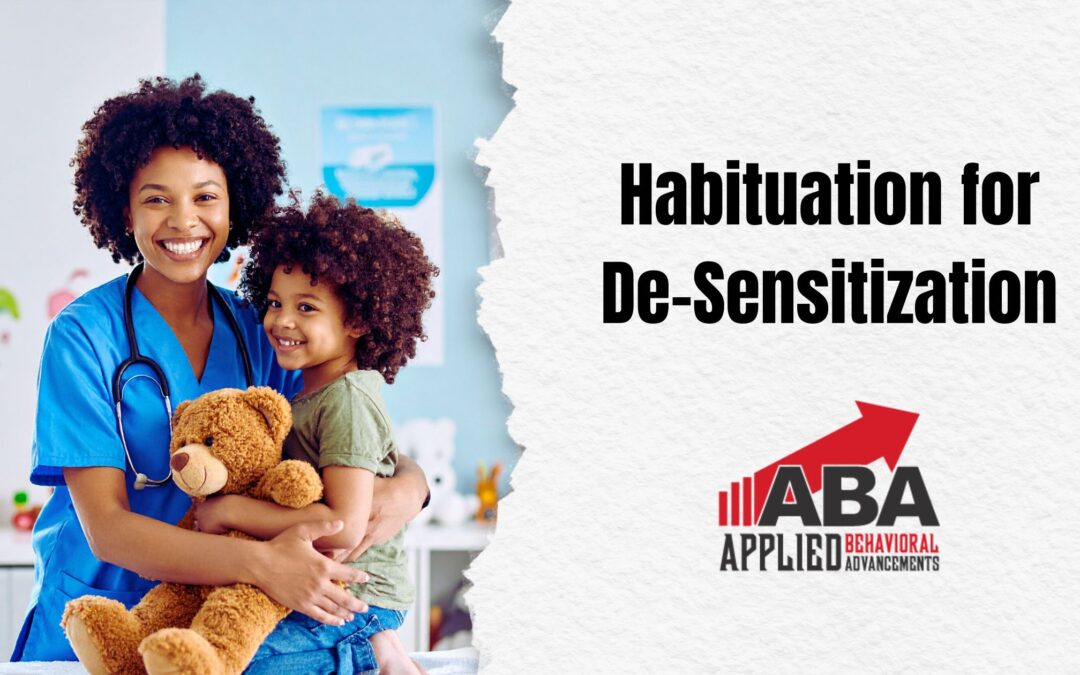
TLBA Kyle Strunk walks parents through the steps of using habituation for de-sensitization. With help from his friend Axel, Kyle demonstrates how parents can slowly introduce aversive stimuli. to help make it less scary for their kids. You can use this technique to help your child become more comfortable with any environment they may struggle with: restaurants, church, the doctor, the dentist, school, etc. Remember, habituation takes repetition and time.
Stethoscope De-Sensitization
- Explain and show Child the stethoscope, what it is, what it does, and why its important.
- Allow Child to hold, look at, and manipulate stethoscope for 1-2 minutes.
- Explain to client that you are going to touch the stethoscope to their arm and it will not hurt, gently touch the stethoscope to clients arm running up and down arm to de-sensitize them to the pressure of it being placed against their skin. Do this for 1-2 minutes.
- Tell Child that you are going to listen to their heart, lungs, and stomach with the stethoscope and that it will not hurt and only take a minute or two. Touch stethoscope over clothing to their heart area lifting and placing back (simulating the Dr. checking the four heart chambers.)
- After this give a break if needed, if not listen to lungs by repeating the x4 lifting and placing as with the heart.
- After, give break if needed, then listen to stomach, again repeating the x4 lifting and placing technique (Simulating the Dr. listening to the 4 quadrants of the digestive system).
Note: Deliver praise and reinforcement upon every completed step.
Blood Pressure Cuff
- Explain to the client what a blood pressure cuff is, what it does, and why it is important.
- Allow client time to hold, explore, and manipulate the blood pressure cuff approximately 1-2 minutes.
- Explain to the client that you are going to wrap the blood pressure cuff around their arm (Model if necessary), and it will feel like it is giving your arm a hug, it would hurt, and it will be over in just a few seconds.
- Ask if a break is needed before continuing, if not wrap blood pressure cuff around client’s arm and pump up x4, then immediately begin slowly releasing air.
Note: Deliver praise and reinforcement upon every completed step.
What is ABA Parent Training?
ABA Parent Training helps parents learn the basics of Applied Behavior Analysis (ABA). While ABA is commonly associated with kids on the autism spectrum, we believe that these data-backed tools can be helpful for everyone. Each video focuses on a different aspect of ABA, and connects our topic to its real world application. Learn how the data-verified science of ABA can help you in your parenting journey! Past topics have included the Function of behavior, prevention strategies, and reinforcement. We are always open to feedback from our audience about what they would like to learn next! Watch our playlist to enjoy the whole series!
About ABA-LLC
ABA-LLC is one of the largest suppliers of Behavior Support in the State of Kentucky. Since 2007, the agency has created innovative strategies to improve the lives of unique individuals. ABA-LLC works with around 190 contractors, each dedicated to building an inclusive culture that celebrates individuals of all abilities. No matter who you are, you can reach your goals at ABA-LLC.
ABA-LLC is set apart from its competitors by its uniquely person-centered approach. The agency strives to provide services from a place of deep love for the population they serve. Their work exemplifies the belief that every individual has a right to live a fulfilling and independent life integrated within their communities. There is no objective to change a person, but rather to give them the tools they need to succeed. B.F. Skinner summarizes this vision in his quote: “I’m not trying to change people. All I want is to change the world in which they live.” Learn more about us at https://aba-llc.com/